
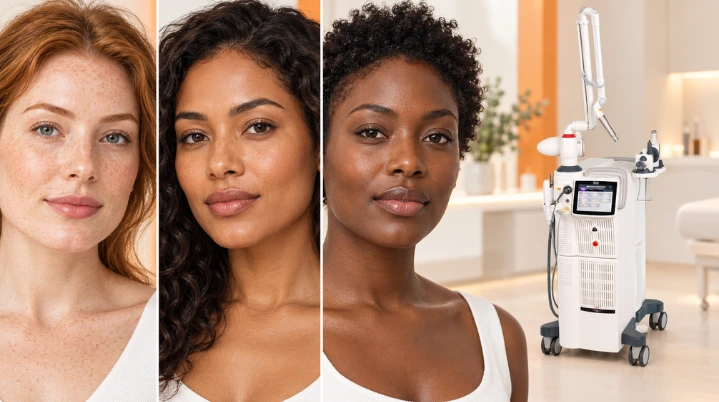
How to Choose the Right Laser for Different Skin Types
Australia is one of the most culturally diverse countries in the world, and that diversity walks through the door of every aesthetic clinic. A laser that performs beautifully on fair skin can cause burns or pigment changes on darker skin if it is the wrong wavelength or used with the wrong settings.
Choosing the right laser for different skin types is about more than avoiding risk. It decides how many patients you can treat safely, how good their results are and how confidently your team can work. This guide explains how skin type affects laser treatment and how to choose equipment that serves your whole patient base.
Why skin type matters in laser treatment
Most aesthetic lasers work by targeting a chromophore, such as melanin in hair or pigmented lesions, haemoglobin in blood vessels or water in the skin. The problem is that the epidermis also contains melanin. The more melanin in a patient’s skin, the more laser energy it absorbs, which increases the risk of:
- Burns and blistering
- Post-inflammatory hyperpigmentation (darkening)
- Hypopigmentation (lightening)
- Scarring in more severe cases
- Poor results if energy must be reduced too far to stay safe
That is why choosing a laser for different skin types starts with understanding how much melanin is in the skin you are treating.
Understanding the Fitzpatrick scale
The Fitzpatrick scale is the most widely used way to classify skin type for laser treatment. It describes how skin reacts to sun exposure.
| Type | Typical description | Sun reaction |
|---|---|---|
| I | Very fair skin, often with red or blond hair | Always burns, never tans |
| II | Fair skin | Usually burns, tans minimally |
| III | Medium skin | Sometimes burns, tans gradually |
| IV | Olive or light brown skin | Rarely burns, tans easily |
| V | Brown skin | Very rarely burns, tans very easily |
| VI | Dark brown to black skin | Never burns |
Fitzpatrick type is a starting point, not the full picture. Ethnic background, recent sun exposure, tanning products, a history of pigmentation problems and how the skin has reacted to previous treatments all matter.
Matching the laser to the skin type
Longer wavelengths penetrate deeper and are absorbed less by melanin in the epidermis, which generally makes them safer for darker skin. Shorter wavelengths are absorbed more strongly by melanin, which can be very effective on lighter skin but riskier on darker skin.
| Technology | Wavelength | Generally best for |
|---|---|---|
| Alexandrite | 755nm | Fitzpatrick I to III |
| Diode | Around 808nm to 810nm | Fitzpatrick I to V |
| Long-pulse Nd:YAG | 1064nm | All skin types, and the preferred option for IV to VI |
| IPL | Broad spectrum light | Mainly lighter skin types, with caution on darker skin |
These are general guides. Settings, pulse duration, cooling and operator skill all have a major effect on safety.
Laser hair removal for different skin types
Laser hair removal for different skin types is where wavelength choice matters most, because hair removal relies on melanin in the follicle while trying to spare melanin in the skin.
- Fair skin with dark hair (I to III): the ideal combination for most lasers. Alexandrite and diode are both highly effective.
- Medium to olive skin (III to IV): diode is often the most versatile option, with Nd:YAG for added safety on deeper tones.
- Brown to dark skin (V to VI): long-pulse Nd:YAG 1064nm is generally the safest choice. Diode may be used on type V with appropriate settings and cooling.
- Light, grey or white hair: lasers are unlikely to be effective on any skin type, as there is too little melanin in the hair.
For a detailed comparison, see our guides to choosing the right laser wavelength for hair removal and alexandrite vs diode laser.
Pigmentation, vascular and resurfacing treatments
Skin type also affects other aesthetic laser treatments.
Pigmentation
Q-switched and picosecond Nd:YAG lasers are widely used for pigmentation and tattoo removal. On darker skin types, treatment needs particular care, as the risk of post-inflammatory hyperpigmentation is higher. Conservative settings and careful spacing between sessions are important.
Vascular concerns
Long-pulse Nd:YAG is commonly used for vascular treatment across a wide range of skin types because of its deep penetration and lower melanin absorption.
Resurfacing and rejuvenation
Ablative and fractional Er:YAG treatments can deliver strong results, but darker skin types need a more cautious approach to reduce the risk of pigment changes. Non-ablative Nd:YAG rejuvenation is often a lower-risk option for deeper skin tones.
Assessing your patient before treatment
Good outcomes start with a thorough consultation. Before any laser treatment, clinicians should:
- Assess skin type using the Fitzpatrick scale and a full medical and treatment history
- Ask about sun exposure and tanning, including fake tan and recent holidays
- Check medications and conditions that increase photosensitivity or affect healing
- Ask about past reactions, such as pigmentation after previous treatments, injuries or acne
- Carry out a test patch where appropriate, and review it before the full treatment
- Set realistic expectations about the number of sessions and likely results
Settings and techniques for darker skin
Even with the right wavelength, safe treatment of darker skin relies on careful technique. Common approaches include:
- Using longer pulse durations to heat the target more gradually
- Starting with conservative energy levels and building up over sessions
- Using effective skin cooling before, during and after each pulse
- Avoiding overlapping pulses and stacking
- Allowing enough time between sessions for the skin to recover
Device-specific training is essential, so operators understand the settings and protocols recommended for each skin type.
Choosing equipment for a diverse patient base
When choosing a laser for different skin types, think about the patients you see today and the patients you want to attract.
- Map your patient mix. Many metropolitan Australian clinics see more Fitzpatrick IV to VI patients than they expect.
- Avoid a single narrow wavelength if your patient base is diverse.
- Consider multi-wavelength platforms that combine options such as diode, alexandrite-type and Nd:YAG wavelengths.
- Look for strong cooling and flexible pulse settings.
- Check clinical evidence for each skin type you plan to treat.
- Make sure training covers darker skin types in detail.
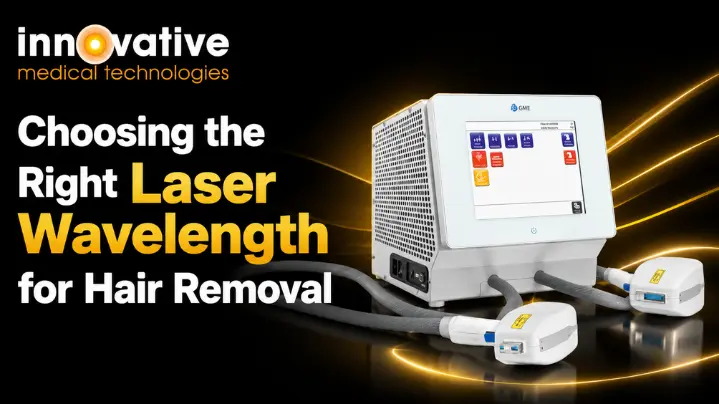
For example, the Fotona SP Dynamis Pro includes Nd:YAG for darker skin types and a range of indications, while the GME TwinScan offers diode-based hair removal across a broad range of skin types.
Final thoughts
There is no single laser that is perfect for every patient. Choosing the right laser for different skin types means understanding how melanin affects each treatment, matching wavelengths to your patient mix, and backing your equipment with careful assessment, sensible settings and thorough training.
Innovative Medical Technologies supplies Fotona and GME laser systems to clinics across Australia and New Zealand, with practical training and ongoing clinical support. If you are planning equipment for a diverse patient base, our team can help you compare technologies and build a shortlist that fits your clinic.
Frequently Asked Questions
What is the safest laser for dark skin?
Long-pulse Nd:YAG 1064nm is generally considered the safest option for darker skin types, as it penetrates deeply and is absorbed less by melanin in the epidermis.
Can you do laser hair removal on darker skin?
Yes, with the right wavelength, settings and cooling. Nd:YAG is commonly used for Fitzpatrick V and VI, and diode can often be used on type V with appropriate settings.
Is alexandrite safe for olive skin?
Alexandrite works best on Fitzpatrick I to III. Some olive skin falls within this range, but deeper olive tones are usually better treated with diode or Nd:YAG.
Why is a patch test important?
A patch test shows how a patient’s skin responds to the chosen settings before a full treatment, helping reduce the risk of burns and pigment changes.
Can tanned skin be treated with a laser?
Recent tanning increases melanin in the skin and raises the risk of side effects. Many clinics delay treatment or adjust settings until the tan has faded.