
Choosing the Right Laser Wavelength for Hair Removal
Wavelength choice is the single most important decision in selecting a laser hair removal machine. Get this right and clinical results follow. Get it wrong and no amount of marketing or training will compensate for patients who do not respond, or who respond poorly because the device was never designed for their skin type.
This guide explains the three clinically validated hair removal wavelengths, what each one does well, and how to match wavelength to your patient mix.
Why Wavelength Matters More Than Any Other Specification
Laser hair removal works by selective photothermolysis. The laser energy is absorbed by melanin in the hair follicle, heats the follicle, and damages it enough to prevent regrowth. Different wavelengths penetrate to different depths and have different absorption characteristics in melanin versus surrounding tissue.
This matters because skin tone (the Fitzpatrick type) also contains melanin. A wavelength that targets follicle melanin well in lighter skin can over-target the epidermis in darker skin, causing burns, pigmentary changes and treatment failure. The clinical safety margin is what separates the three wavelengths used in modern hair removal.
Alexandrite 755 nm
Alexandrite is the fastest and most efficient wavelength for lighter skin types. It is strongly absorbed by melanin, which allows for short pulse durations and quick treatment times.
Best for: Fitzpatrick types I to III
Limitations: Higher risk on darker skin types — generally avoided in Fitzpatrick IV to VI
Treatment speed: Among the fastest available
Ideal clinic profile: Aesthetic and dermatology clinics treating predominantly lighter-skinned patients
Innovative’s AvalancheLase from Fotona uses Alexandrite 755 nm with the Avalanche effect — multiple sub-threshold pulses delivered to the same area to build up absorption gradually. This improves comfort and efficacy with the largest spot size available on the market.
Diode 808 nm
Diode is the all-rounder. It penetrates more deeply than Alexandrite, has good safety across most skin types, and the newer linear-scanning systems deliver impressive treatment speed.
Best for: Most skin types, with caveats for the very darkest Fitzpatrick types
Limitations: Slightly slower per pulse than Alexandrite on light skin; less suitable than Nd:YAG on Fitzpatrick VI
Treatment speed: Very fast with modern sliding-mode scanners
Ideal clinic profile: High-volume body work; clinics with broad patient demographics
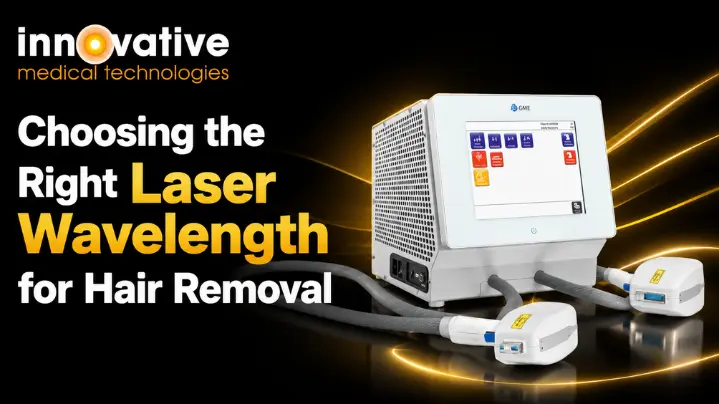
GME TwinScan, distributed by Innovative, uses diode 808 nm with three operating modes. Stamping Mode handles precise areas like the upper lip and bikini line. Sliding Mode moves quickly across large body areas such as legs and back. Super Mode prioritises patient comfort. Two applicators are available — the f-HP for large body areas and the lightweight p-HP for small or precise zones.
Nd:YAG 1064 nm
Nd:YAG penetrates the deepest of the three wavelengths and is the only option considered safe for the darkest Fitzpatrick types.
Best for: Fitzpatrick IV to VI
Limitations: Less efficient on light skin compared with Alexandrite
Treatment speed: Slower per pulse than the other wavelengths on equivalent areas
Ideal clinic profile: Clinics with significant Mediterranean, Middle Eastern, South Asian, African or mixed patient bases
Fotona SP Dynamis combines high-performance long-pulse Nd:YAG with surgical QCW Nd:YAG, giving you hair removal capability alongside vascular treatments, skin rejuvenation and additional aesthetic indications on a single platform.
Multi-wavelength Platforms
A single-wavelength system is the right choice for a clinic with a clear patient mix and a focused treatment menu. A multi-wavelength platform makes sense for clinics with broader patient demographics or those planning to expand the treatment menu over time.
Innovative’s Fotona StarWalker MaQX, while best known for tattoo removal and pigmentation work, also supports facial hair removal through its VERSA3, FRAC3 and MaQX modalities. A clinic seeking versatility on one platform should evaluate this kind of system against the dedicated single-wavelength options.
Matching Wavelength to Your Patient Mix
Three steps work for most clinics:
- Map your current and target patient mix by Fitzpatrick skin type. Most clinics underestimate the proportion of types IV to VI in their patient base, particularly in metropolitan Australia where demographics have shifted significantly over the last decade.
- Identify the treatment areas you will service most often. Body work demands different speed and spot-size considerations than precision facial work.
- Match the wavelength (or wavelength combination) that covers your patient mix and your treatment menu.
If most of your patients fall into types I to III, an Alexandrite-only platform like AvalancheLase will be the fastest and most efficient choice. If you treat a broad demographic across types I to V, a diode platform like GME TwinScan or a Nd:YAG-equipped Fotona SP Dynamis is more flexible. For clinics expecting heavy demand from Fitzpatrick V to VI patients, Nd:YAG is essential rather than optional.
The Final Word on Wavelength Choice
Wavelength choice is where most clinics get hair removal right or wrong. The three established wavelengths each have a clear clinical profile, and once you know your patient mix, the match is straightforward.
If you would like a tailored recommendation based on your current and target patient demographic, our team will walk you through the right wavelength and platform for your clinic.