
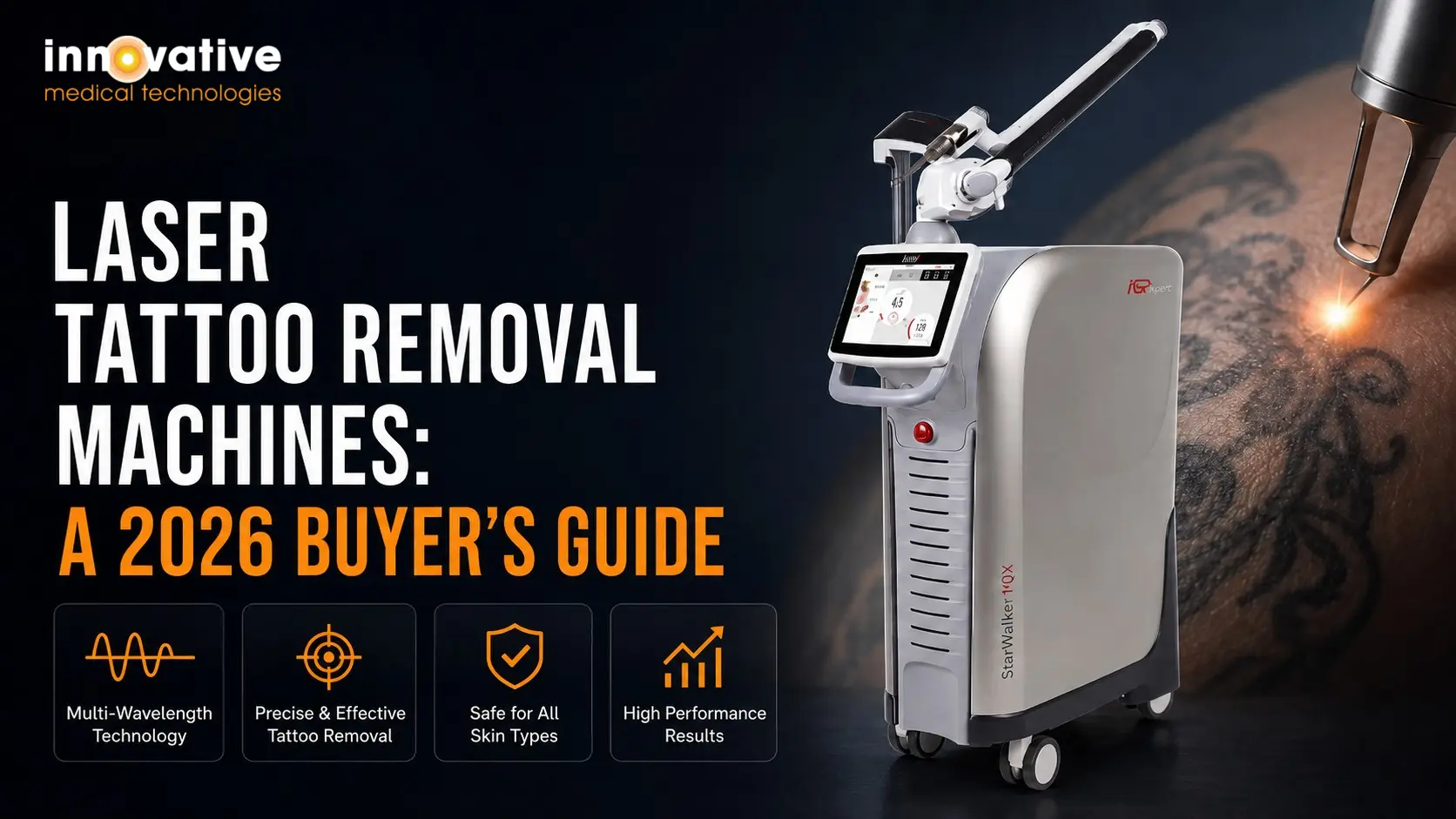
Laser Tattoo Removal Machines: A 2026 Buyer’s Guide
Tattoo regret is a steadily growing service area in Australian clinics, driven by changing aesthetic preferences and the maturing of patients who were tattooed in their twenties. For clinics evaluating a laser tattoo removal machine, the buying decision is more complex than it looks on a brochure. Wavelengths, pulse durations, spot sizes and clinical versatility all interact in ways that determine which patients you can safely treat and how quickly results appear.
This guide covers the decisions that matter most.
How Modern Laser Tattoo Removal Works
Tattoo ink sits in the dermis as particles too large for the body to clear. A laser tattoo removal machine delivers very short, very high-energy pulses that are absorbed by those pigments. The energy transfers into a photoacoustic shockwave that breaks the ink into fragments small enough for the immune system to remove over the following weeks.
This is why pulse duration matters. Shorter pulses generate less heat in surrounding tissue and produce a stronger mechanical effect on the ink. Patients see faster fading with lower risk of thermal injury.
Wavelength Coverage Matters More Than Wavelength Count
Different ink colours absorb different wavelengths. A tattoo removal laser limited to one wavelength will struggle with multi-colour tattoos. The two clinically essential wavelengths are:
- 1064 nm Nd:YAG — the workhorse for black and dark blue inks, and the safest option for darker Fitzpatrick skin types
- 532 nm KTP Nd:YAG — for red, orange and yellow ink
Multi-wavelength platforms add further wavelengths to address blue, purple and green inks. Fotona’s StarWalker, distributed by Innovative across Australia and New Zealand, supports multi-wavelength Q-switched coverage on a single system.
Q-switched, Picosecond, or Both
Q-switched lasers produce nanosecond pulses. They have decades of clinical evidence behind them and remain the most widely used technology for tattoo removal.
Picosecond pulses are a thousand times shorter again. The shorter pulse produces a stronger photomechanical effect on the ink, which can mean fewer sessions for some patients and improved results on stubborn colours such as green and pale blue.
The honest reality is that both work clinically. Q-switched platforms treat most tattoos effectively at a lower entry cost. Picosecond and pico-power systems are better suited to clinics that plan to treat complex multi-colour or recalcitrant tattoos as a core service.
Innovative’s Fotona StarWalker uses ASP (Adaptive Structured Pulse) technology to combine high peak energy Q-switched output with pico-style pulse shaping. It also supports FracTAT, a fractional ablative procedure that creates micro-channels in the skin to allow gas release during treatment, helping the laser reach deeper pigments more effectively in fewer sessions.
What Else Can The Machine do
Most tattoo removal platforms have applications beyond tattoo. Pigmented lesions, melasma, sun damage and certain types of skin revitalisation use overlapping technology.
When you specify a tattoo removal machine, ask which other clinical indications the same platform handles, and whether each indication requires additional handpieces, licences or training. StarWalker, for example, also offers VERSA3, FRAC3 and MaQX modalities used for pigment correction and skin revitalisation. For a clinic looking to expand a treatment menu over time, a multi-application platform changes the return-on-investment maths.
Training, Licensing and ARTG Compliance
Class 4 medical lasers in Australia require ARTG registration on the supplier’s part, a nationally recognised laser safety course completed by every operator, and state-based licensing in Queensland, Western Australia, Tasmania and the ACT. A Designated Laser Safety Officer must also be identified and documented in the clinic.
Before signing any quote, confirm:
- The supplier provides full ARTG documentation for your records
- Manufacturer-led training covers theory, hands-on practice and ongoing case support
- The supplier helps with laser safety course access if your operators do not yet hold one
A supplier who hands you the device and a manual is leaving you to fail.
Total Cost is Not The Sticker Price
For tattoo removal specifically, the line items that catch clinics out most often are:
- Handpiece replacement cycles — high pulse counts shorten handpiece life
- Cooling system maintenance and consumables
- ARTG and compliance documentation
- Annual service contracts
- Marketing collateral — patient brochures, social media assets, before-and-after templates
Get all of these in writing across a five-year horizon before you compare quotes.
What to Ask Every Supplier
Ask each supplier the same questions, and compare answers side by side.
- What wavelengths does the system deliver, and which ink colours does each wavelength target?
- Is the system Q-switched, picosecond, or a hybrid platform?
- What is the ARTG registration number?
- What training does the purchase include, and how long until operators are independent?
- Who else in my state is using this exact configuration, and can I speak with them?
- What is the technical service response time in my state?
- What does year-one and year-five cost of ownership look like in writing?
Suppliers who answer these clearly are worth working with. Suppliers who deflect are signalling what the next five years will look like.
The bottom line on choosing a tattoo removal laser
Choosing a laser tattoo removal machine is a clinical decision, a business decision and a partnership decision. Get all three right and your investment pays back across years.
If you would like to discuss device options matched to your patient mix and treatment goals, our team will walk you through the right configuration for your clinic.