
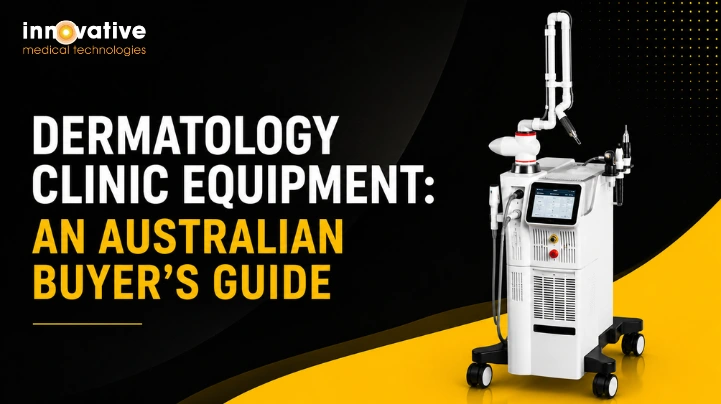
Dermatology Clinic Equipment: An Australian Buyer’s Guide
Equipping a dermatology clinic in Australia is a different exercise to equipping an aesthetic clinic. The patient base, the clinical scope and the regulatory environment all add layers. The investment is also typically larger, because dermatology equipment spans diagnostic, therapeutic and specialist categories rather than focusing on a few aesthetic indications.
This guide covers the main equipment categories for an Australian dermatology practice, the trade-offs that matter at each level, and what to ask suppliers before committing to a purchase.
The four equipment categories
Most dermatology clinics need equipment across four broad categories:
Diagnostic equipment
Dermatoscopes, total body imaging, biopsy supplies and skin examination tools.
Therapeutic lasers and light-based systems
For vascular lesions, pigmentation, scarring, hair removal and other clinical indications.
Cooling and patient comfort systems
Used during laser and other treatments to protect skin and improve patient experience.
Surgical and minor procedure equipment
For cyst removal, mole excision, biopsies and other procedural work.
A new clinic typically invests across all four. An established clinic adding new service lines may invest in one or two at a time.
Therapeutic lasers — the main capital line
For dermatology, laser equipment is usually the largest single capital line. The clinical scope determines which platforms matter most.
Vascular and pigment treatments
Long-pulse Nd:YAG is the workhorse for vascular lesions such as telangiectasia, rosacea redness, port wine stains and reticular veins. Q-switched and pico-power Nd:YAG systems handle pigmentation indications including melasma, lentigines, sun damage and post-inflammatory hyperpigmentation.
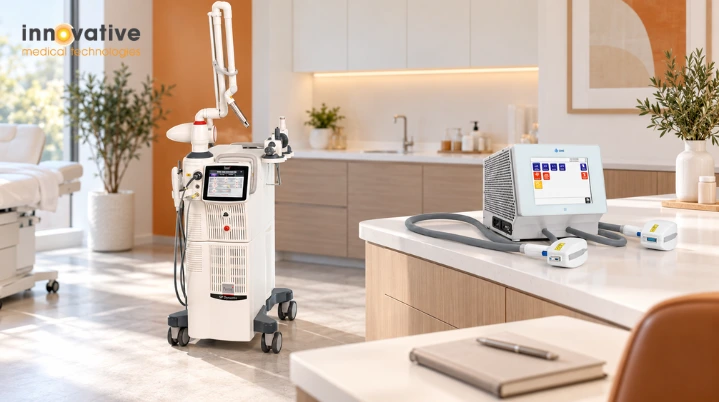
Innovative’s Fotona SP Dynamis combines long-pulse and QCW Nd:YAG on one platform, suiting dermatology clinics that need broad treatment capability across hair removal, vascular and skin rejuvenation indications.
Resurfacing and scar treatment
Er:YAG and CO2 fractional lasers handle ablative resurfacing for acne scars, surgical scars, textural irregularities and dermatology-specific resurfacing indications. These platforms sit at the higher end of equipment investment but have strong clinical evidence in indications where non-ablative options reach a ceiling.
Multi-application platforms
For dermatology clinics with broad clinical scope, multi-application platforms can be more efficient than several single-purpose devices. Fotona’s range, distributed by Innovative across ANZ, includes platforms that combine multiple laser sources and modalities on one console.
The trade-off is investment size and training depth. A multi-application platform requires the clinical team to maintain proficiency across more indications than a single-purpose device does.
Cooling systems
Patient comfort and skin protection are essential during laser treatments. Modern cooling systems blow chilled air across the treatment area during the procedure, reducing pain and protecting the epidermis from thermal injury.
Zimmer’s Cryo systems, distributed by Innovative in Australia, are widely used across Australian dermatology and aesthetic clinics. The Cryo-7 in particular has become a standard accessory for laser-equipped dermatology rooms.
Cooling systems are not optional luxury equipment. They are part of clinical best practice and patient retention for any clinic running laser treatments.
Compliance — what dermatology clinics need to confirm
Dermatology clinics carry the same Class 4 laser compliance requirements as aesthetic clinics, plus a few additional considerations.
For every laser platform, confirm:
- ARTG registration is current and documentation is available
- Manufacturer-led clinical training is included for every operator
- The Laser Safety Course is completed by every staff member who will operate the device
- State-specific licensing is in place — QLD, WA, TAS and the ACT have additional rules
- A Designated Laser Safety Officer is identified and documented
For dermatology specifically, also confirm:
- The platform has indication-specific clinical evidence for the treatments planned
- The supplier provides clinical case study access for the configurations you intend to use
- Service response time in your state is documented in writing
- Consumables, calibration and software update costs are clear across a five-year horizon
The supplier relationship
Dermatology equipment is bought once and lived with for a decade. The supplier behind the device matters as much as the device itself.
The right supplier provides:
- Manufacturer-led clinical training delivered by qualified educators
- Australian-based technical support and engineering
- Marketing collateral and patient education materials
- Ongoing clinical case review support
- Access to reference customers in your region
The wrong supplier provides a quote, a delivery, and not much else. The difference shows up in years two through five, when the clinical team is working through edge cases and the patient complications every laser-equipped clinic eventually faces.
Plan the timeline
A new dermatology clinic typically takes four to six months from supplier shortlist to first patient treatment. The biggest delays usually come from:
- Laser safety course scheduling for operators
- State licensing applications (particularly in QLD and WA)
- Equipment delivery and installation lead times
- ARTG documentation and clinic policy setup
If you are planning a clinic opening or a new service line addition, work backwards from the target launch date and add buffer for the compliance work.
Final considerations for your dermatology investment
Equipping a dermatology clinic is a significant capital exercise — and the equipment choices made early will shape the clinical scope and patient outcomes for years.
If you are at the planning stage and would like to discuss equipment options for your dermatology clinic, our team works with established dermatology and aesthetic practices across Australia and New Zealand. We will walk through the clinical scope, the patient base and the growth plan to help build an equipment shortlist that fits.