
How to Choose a Laser Hair Removal Machine for Your Clinic: A 2026 Buyer’s Guide
Most clinic owners come to us asking the wrong question.
“Which laser hair removal machine is the best?”
We get it. It’s the question on every comparison spreadsheet, in every supplier brochure, on every industry forum thread. But after nearly two decades fitting out Australian and New Zealand aesthetic and medical clinics with laser equipment, we can tell you flatly: there isn’t a best machine. There is only the right machine for your patient demographic, your treatment volume, and the kind of clinic you’re building.
This guide is about asking the right questions before you start comparing spec sheets — and giving you the framework to figure out which device actually fits your clinic. We’ll also share the questions to ask the suppliers competing for your investment, and the red flags that tell you to walk away.
1. Start with your patients, not your shortlist
The single biggest predictor of laser hair removal success in an Australian clinic isn’t the device. It’s the match between the device’s wavelength and the patient demographic you actually treat.
Get this wrong, and nothing else matters.
We see this play out regularly. A clinic in an inner-Melbourne suburb with a predominantly Mediterranean and Middle-Eastern patient base buys an Alexandrite-only system because that’s what was demoed at a recent conference. Six months later, they’re frustrated — efficacy on darker Fitzpatrick types is underwhelming, treatment endpoints aren’t where they should be, and patients are quietly drifting to a competitor running Nd:YAG. The device is excellent. It just doesn’t match the postcode.
Before you look at any product, map out three things:
- Your current patient mix by Fitzpatrick skin type. Most clinics underestimate the proportion of types IV–VI in their patient base, especially in metropolitan Australia where demographics have shifted significantly over the last decade.
- The treatment areas you’ll actually be servicing. Bikini, underarms and legs need different spot-size and speed considerations than precision facial work on the upper lip or chin.
- Your patient acquisition strategy. If you’re targeting the bridal and wedding-prep market, you need fast treatment turnaround. If you’re a medical practice with a referred caseload, throughput matters less than versatility and clinical evidence.
Multi-wavelength platforms exist precisely so that clinics with broad patient demographics don’t have to make the wrong-call mistake at the wavelength stage. They cost more upfront, but they eliminate the patient-rejection problem entirely — you can treat the patient sitting in front of you, regardless of skin type.
2. Be honest about your treatment volume
Most clinics overestimate the volume they’ll deliver in the first 18 months. That’s not a criticism — it’s just human optimism meeting market reality.
This matters because it changes the device you should be buying.
When we work through device selection with a clinic, we ask three questions before anything else:
- How many laser hair removal sessions can you realistically deliver per week, given your current chair hours and staff capacity?
- What monthly marketing budget will you commit to filling those chairs — and have you committed to it in writing?
- What are your honest six-month, 12-month and 24-month volume targets, and what evidence supports them?
If the realistic answer is 15–25 sessions a week, you don’t need the fastest scanner on the market. The treatment-time savings won’t be felt at that volume — but the price difference will. If the realistic answer is 60+ sessions a week, scanner speed and treatment efficiency become the difference between profitable and slammed.
There’s no shame in starting smaller. We’ve supplied clinics that started with a single-wavelength workhorse and added a second platform 18 months later when volume justified it. That’s a smarter sequence than buying a Ferrari and using it like a Camry.
3. Specialist platform or multi-application system?
This is the strategic question most clinics skip entirely — usually because they didn’t realise it was a question.
A specialist hair removal device does one thing exceptionally well. A multi-application platform does hair removal alongside other modalities — pigmentation, vascular work, skin rejuvenation, or in some cases tattoo removal. Both choices are defensible. They lead to fundamentally different clinics.
The specialist route fits when:
- You’re building a high-volume hair removal book and want every operational decision pointed in one direction
- You want simple training, fast staff onboarding, and predictable workflow
- Your other treatments are delivered on dedicated platforms (which suits clinics with floor space and a multi-device strategy)
The multi-application route fits when:
- Floor space is limited and you need one platform to earn multiple revenue lines
- Your patient base is interested in cross-treatment journeys — hair removal patients are warm prospects for skin rejuvenation, pigmentation work, and vascular treatments
- You’re prepared to invest in deeper clinical training across modalities, and your treating staff are credentialed accordingly
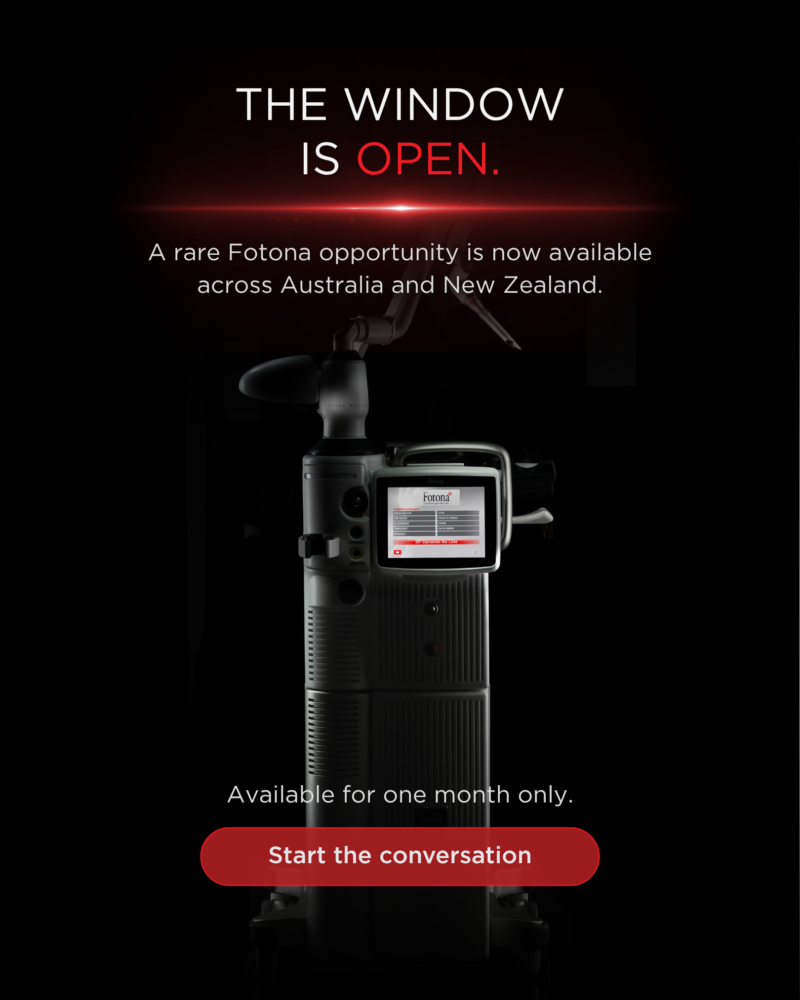
Platforms like the Fotona SP Dynamis sit firmly in the multi-application camp — combining long-pulse and QCW Nd:YAG to cover hair removal, vascular treatments and skin rejuvenation on one console. A diode system like the GME TwinScan sits firmly in the specialist camp — built for speed, comfort and throughput on hair removal specifically.
Neither is “better.” They’re choices about what kind of clinic you’re running.
4. Scanner technology and what speed actually buys you
Here’s the easiest place to overspend on laser equipment: paying for speed you can’t use.
Modern scanning technology — particularly the sliding-mode systems in newer diode platforms — can deliver full-leg treatments in under 15 minutes. That’s transformative if your business model depends on high session throughput. It’s largely irrelevant if your appointment slots are 30 minutes regardless of treatment time.
When evaluating scanner technology, ask three things:
- What’s the realistic treatment time for the procedures I actually do most? Get this in minutes, at clinical energy settings — not the showroom maximum.
- How does the device handle small areas as well as large? Some scanners are optimised for full-leg work and become awkward on the upper lip, bikini line or eyebrow.
- What’s the patient experience trade-off? Faster sometimes means less comfortable. The best platforms now offer multiple modes — fast for body, gentle for face.
For most clinics, treatment speed is a comfort-and-capacity issue rather than a cost issue. Where speed does become a cost issue: when it allows you to add chair hours without adding staff, or to handle peak-season demand without losing patients to wait times. If neither of those describes your operation, don’t pay the premium.
5. The hidden cost reveal – what’s actually included
The device price you see on the quote is rarely the total cost of ownership. We’ve seen clinics get caught out on the same three lines, year after year.
Clinical training
A laser hair removal machine you can’t operate confidently is an expensive paperweight. Look for manufacturer-led training that includes structured theory, hands-on practical, and ongoing case-review support after installation. If your supplier’s training offer is a one-day session and a manual, that’s a red flag, not a deal.
Laser safety and compliance
In Australia, your clinic needs a designated laser safety officer, documented compliance procedures, and team members who’ve completed certified laser safety training. State requirements vary significantly — Queensland, Western Australia, Tasmania and the ACT each have specific licensing rules that have caught more than a few clinic owners off-guard at the worst possible moment. Confirm that your supplier supports compliance documentation and either offers or refers you to accredited laser safety courses.
Service, warranty and consumables
Cooling system maintenance, handpiece replacement cycles, calibration costs, response times for technical issues. Get the numbers in writing for years one through five. A device with a cheaper purchase price and a four-figure annual service plan often isn’t cheaper at all — it just looks that way at signing.
Marketing collateral
Some suppliers include patient brochures, social media assets, and consultation tools as part of the relationship. Some don’t. This isn’t a deal-breaker, but it is worth knowing what you’ll need to produce yourself in the first 90 days when your device needs to start filling chairs.
6. Some questions to ask every supplier
Use these in your supplier conversations. The quality of the answers will tell you more than any brochure ever will.
1. What is the regulatory and ARTG status of this device in Australia?
Every therapeutic laser device sold in Australia must be on the Australian Register of Therapeutic Goods. If the answer is vague or evasive, end the conversation.
2. Can I see clinical case studies from Australian clinics using this exact configuration?
Not the global marketing glossy — the actual case studies from clinics that look like yours, treating patients who look like yours.
3. What does the training programme cover, and how long until my team is treating independently?
Look for a specific answer with concrete timelines, not vague reassurances.
4. What’s the response time for technical service in my state?
“Australian-based support” can mean very different things in practice. Ask for the actual service-level agreement, in writing.
5. What’s the typical full lifecycle cost across three to five years, including service and consumables?
A reputable supplier will give you ranges and assumptions. A supplier that deflects this question is hiding something.
Where to go from here
The right laser hair removal machine for your clinic isn’t a product. It’s a fit — between your patients, your team, your treatment volume and the clinic you’re building over the next decade.
The questions in this guide are the same ones we work through with every clinic that books a consultation with us. If you’d like to skip the comparison spreadsheets and get a tailored shortlist based on your patient demographic, treatment goals and current clinic stage, our clinical team is the best place to start.
Book a clinical consultation →
Thirty minutes with our team. We’ll review your patient mix, treatment plans and growth goals, and recommend the right device — or tell you honestly if you’re not quite ready to invest yet.