
Alexandrite vs Diode Laser: Which Is Better for Your Clinic?
Laser hair removal is one of the most requested treatments in Australian clinics, and it can be one of the most reliable revenue lines. When it comes to choosing the device, the conversation often narrows to two technologies: alexandrite and diode.
Both are proven, both are used in clinics around the world, and both can deliver excellent results in the right hands. The difference lies in how they interact with skin and hair, and which patients they serve best. This guide compares alexandrite vs diode laser technology so you can decide which is the right fit for your clinic.
The short answer
Alexandrite lasers are excellent for fine and lighter hair on fair skin, with fast treatment and strong melanin absorption. Diode lasers are more versatile, treating a broader range of skin types safely, with fast scanning and generally lower running costs. If your clinic sees a diverse patient base, a diode or multi-wavelength system is usually the more flexible choice.
How laser hair removal works
Hair removal lasers target melanin, the pigment in the hair follicle. The laser energy is absorbed by the melanin, converted to heat and used to damage the follicle’s ability to regrow hair. The challenge is that melanin in the skin also absorbs energy, so the wavelength has to be chosen carefully to target the hair while protecting the surrounding skin.
The wavelength, pulse duration, spot size and cooling all affect how safely and effectively this works. Our guide to choosing the right laser wavelength for hair removal explains this in more detail.
Alexandrite laser hair removal
Alexandrite lasers emit light at 755nm. At this wavelength, melanin absorption is very strong, which makes alexandrite laser hair removal highly effective on lighter skin with dark hair, and better than many systems at treating finer and lighter hair.
Strengths
- Strong melanin absorption for efficient follicle targeting
- Effective on finer hair and lighter hair colours
- Fast treatments with large spot sizes
- Well established, with a long clinical track record
Limitations
- Works best on Fitzpatrick skin types I to III
- Higher risk of burns and pigment changes on darker skin
- Many systems are larger and may need more maintenance over time
Diode laser hair removal
Diode lasers most commonly emit light at around 808nm to 810nm. This wavelength penetrates deeper than alexandrite and is absorbed less strongly by skin melanin, which gives diode laser hair removal a wider safety margin across skin types.
Strengths
- Safe and effective across a broad range of skin types
- Deeper penetration for coarse and deeper follicles
- Fast scanning and sliding techniques for large areas
- Compact, robust systems with generally lower consumable costs
Limitations
- Less effective than alexandrite on very fine or light hair
- Not as safe as Nd:YAG for the darkest skin types (Fitzpatrick VI)
Alexandrite laser vs diode laser at a glance
| Factor | Alexandrite | Diode |
|---|---|---|
| Wavelength | 755nm | Around 808nm to 810nm |
| Melanin absorption | Very strong | Strong, with deeper penetration |
| Best skin types | Fitzpatrick I to III | Fitzpatrick I to V |
| Best hair types | Dark hair, including finer and lighter hair | Dark, coarse and deeper hair |
| Treatment speed | Fast, with large spot sizes | Fast, especially with scanning or sliding modes |
| Comfort | Depends on cooling | Depends on cooling, often well tolerated with gliding techniques |
| Versatility | Narrower patient range | Broader patient range |
| Running costs | Can be higher, depending on the system | Generally lower |
No hair removal laser is effective on white, grey or very light blonde hair, as there is too little melanin to target.
Which patients does your clinic see?
The most important question in the alexandrite vs diode laser decision is your patient mix. Many metropolitan Australian clinics see more patients with Fitzpatrick skin types IV to VI than they expect, and a laser that is only safe for lighter skin will limit who you can treat.
- Mostly fair skin with dark hair: alexandrite performs extremely well.
- A broad mix of skin types: diode offers more flexibility and a wider safety margin.
- Many patients with very dark skin: consider Nd:YAG 1064nm, either alone or as part of a multi-wavelength platform.
Treatment speed and comfort
Both technologies can deliver fast treatments. Alexandrite systems often use large spot sizes for quick coverage, while many diode systems use scanners or sliding techniques to treat large areas such as backs and legs efficiently.
Comfort depends heavily on cooling. Contact cooling, air cooling and cryogen spray all help protect the skin and improve tolerability. When comparing devices, ask about the cooling method and how it performs in a full day of treatments.
Running costs and reliability
Beyond the purchase price, consider the cost of keeping the laser running. Diode lasers are generally compact solid-state systems with fewer consumables. Some alexandrite systems have components that need periodic replacement, which can add to running costs. Ask each supplier for a clear breakdown of servicing, consumables and expected lifespan, and compare the total cost of ownership over five or more years.
What about combining both?
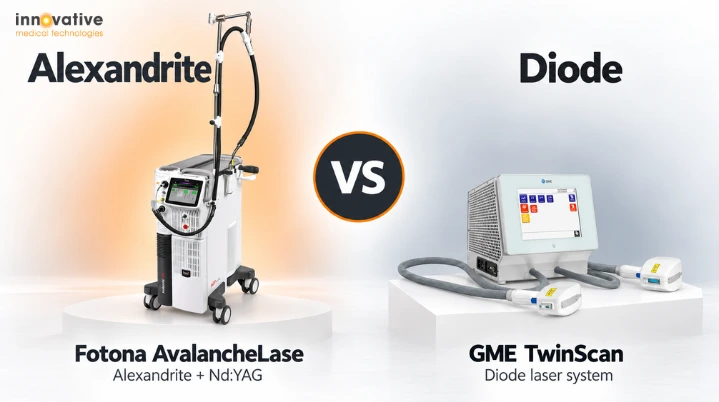
Some modern systems offer both alexandrite and diode wavelengths, or a diode-based alexandrite wavelength, in a single platform. For example, the GME TwinScan offers an 808nm diode handpiece alongside an alexandrite-like wavelength handpiece. This gives clinics the efficiency of alexandrite for lighter skin and finer hair, plus the versatility of diode for a broader range of patients.
For clinics wanting to add other treatments, multi-application platforms that include Nd:YAG can cover darker skin types and additional indications from one console.
So, what is the best laser for hair removal?
There is no single best laser for hair removal for every clinic. The right choice depends on who you treat and how you plan to grow.
- Choose alexandrite if most of your patients have fair skin and you want strong results on finer hair.
- Choose diode if you see a diverse patient base and want versatility, speed and lower running costs.
- Choose a dual or multi-wavelength system if you want the strengths of both, or need to treat very dark skin types safely.
Questions to ask before you buy
- What skin and hair types will this laser treat safely and effectively?
- What cooling does it use, and how comfortable is it for patients?
- How fast is a full back or full leg treatment?
- Is the device included on the ARTG for hair removal?
- What training, service and clinical support are included?
- What are the ongoing servicing and consumable costs?
For a wider buying framework, see our guide on how to choose a laser hair removal machine for your clinic.
Final thoughts
In the alexandrite vs diode laser debate, both technologies have a clear place. Alexandrite excels on lighter skin and finer hair, while diode offers broader safety and versatility for diverse patient bases. Many clinics find that a dual-wavelength system gives them the best of both.
Innovative Medical Technologies supplies hair removal systems from GME and Fotona, with training and Australia-wide service and support. If you are comparing options, our team can talk through your patient mix, treatment volume and growth plans, and help you choose the right technology.
Frequently Asked Questions
Is alexandrite or diode better for hair removal?
Neither is better for every clinic. Alexandrite is excellent on fair skin and finer hair, while diode is more versatile across skin types. The best choice depends on your patients.
Is diode laser safe for darker skin?
Diode lasers are generally safe for a broad range of skin types, up to around Fitzpatrick V. For the darkest skin types, Nd:YAG 1064nm is usually recommended.
Which is faster, alexandrite or diode?
Both can be fast. Alexandrite systems often use large spot sizes, while many diode systems use scanning or sliding techniques to cover large areas quickly.
Which laser is more painful?
Comfort depends more on the cooling system, settings and technique than on the wavelength alone. Many diode systems with gliding techniques are well tolerated.
Can one device offer both alexandrite and diode wavelengths?
Yes. Some systems, such as the GME TwinScan, offer an alexandrite-type wavelength and an 808nm diode wavelength in one platform.