
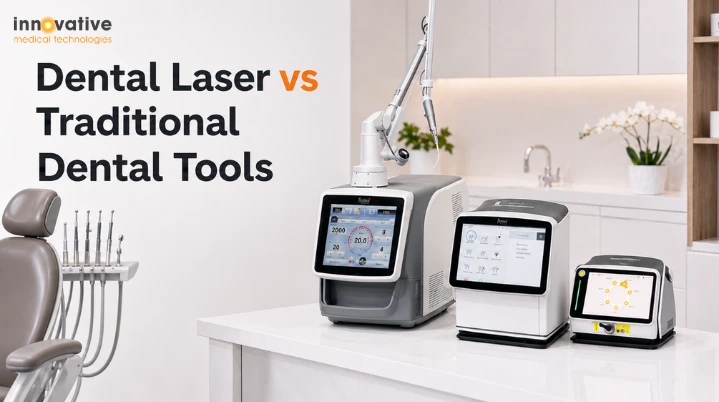
Dental Laser vs Traditional Dental Tools: What’s the Difference for Modern Dental Practices?
Dental practices have relied on rotary instruments, hand instruments and surgical tools for decades. These tools remain essential in modern dentistry.
Dental lasers give dentists another way to perform selected procedures.
The important question is not whether a dental laser is better than every traditional dental tool. The useful question is where laser technology can change the way a specific procedure is performed and whether those capabilities fit the needs of the practice and its patients.
Dental lasers can be used across hard tissue and soft tissue applications depending on the laser system, wavelength and intended procedure. Innovative Medical Technologies currently supplies dental laser systems including Fotona LightWalker, Fotona SkyPulse and Pioon diode laser systems for different dental applications.
Understanding the differences can help dentists decide where a laser fits into an existing clinical workflow.
What Is the Main Difference Between Dental Lasers and Traditional Dental Tools?
Traditional dental instruments usually rely on mechanical contact with the tooth or tissue.
Rotary instruments physically remove tooth structure. Surgical instruments mechanically cut or manipulate soft tissue.
A dental laser uses concentrated light energy delivered to a targeted treatment area.
Innovative describes dental laser treatment as using a narrow, focused energy beam that allows the dentist to work on targeted areas. Its dentistry information states that this can help conserve healthy tooth or gum structure in suitable procedures.
The practical difference depends on what the dentist is treating.
A laser does not replace every bur, scaler, hand instrument or surgical tool. Instead, it gives the dentist another treatment method for procedures where the laser’s clinical capabilities are appropriate.
Hard Tissue and Soft Tissue Lasers Are Not the Same
One of the most important factors when comparing dental lasers is the tissue the system is designed to treat.
Some dental lasers focus mainly on soft tissue.
Other systems provide hard tissue and soft tissue capabilities.
Fotona LightWalker
Innovative lists the Fotona LightWalker as a dual wavelength dental system using:
- Nd:YAG at 1064 nm
- Er:YAG at 2940 nm
The LightWalker is listed for both soft tissue and hard tissue dental applications.
According to Innovative’s current dentistry information, its applications include conservative dentistry, endodontics, implantology, oral surgery, periodontics, ceramic debonding, tooth desensitisation and other dental procedures.
Fotona SkyPulse
Innovative describes SkyPulse as a compact dental laser with soft tissue and hard tissue capabilities.
The system is also used for endodontic applications, including SSP and SWEEPS protocols for root canal irrigation.
Pioon diode systems
Innovative’s dental range also includes Pioon diode lasers.
The currently listed systems include:
- UTU with 950 nm, 650 nm, 450 nm and 405 nm wavelengths
- S3 Plus with 950 nm, 650 nm and 450 nm wavelengths
- Mercury with 950 nm, 650 nm and 450 nm wavelengths
- H1 with either 980 nm or 810 nm
Innovative positions these systems for soft tissue and other specified dental laser applications.
This is why dentists should compare dental lasers by intended application rather than treating all dental laser systems as interchangeable.
Dental Laser vs Traditional Tools at a Glance
| Consideration | Dental Laser | Traditional Dental Tools |
|---|---|---|
| Method | Uses focused light energy | Uses mechanical instruments |
| Tissue capabilities | Depends on laser type and wavelength | Different instruments are selected for different tissues |
| Contact with treatment area | Some procedures can involve less mechanical force | Rotary and hand instruments usually involve mechanical contact |
| Precision | Can target selected tissue precisely in suitable procedures | Precision depends on the instrument and operator technique |
| Bleeding in soft tissue procedures | Innovative reports reduced bleeding in suitable laser surgical procedures | Conventional cutting can require conventional bleeding control |
| Anaesthesia | Innovative states that anaesthesia can sometimes be reduced, localised or avoided in suitable procedures | Anaesthesia is commonly used when clinically required |
| Endodontic use | Selected laser systems can support laser-assisted irrigation protocols | Conventional instrumentation and irrigation remain part of endodontic treatment |
| Hard tissue cutting | Requires a system designed for hard tissue applications | Rotary instruments are widely used |
| Training | Device-specific laser education is required | Dentists learn conventional instruments through standard clinical training |
| Role in practice | Complements the existing clinical toolkit | Remains fundamental to routine dentistry |
The exact result depends on the patient, diagnosis, treatment plan, device and practitioner. A laser should not be promoted as removing the need for conventional dentistry in every case.
Where Can Dental Lasers Change the Treatment Process?
1. Hard Tissue Procedures
Traditional restorative procedures often use rotary instruments to remove tooth structure.
For a laser system designed for hard tissue, the dentist has another method available for selected procedures.
Innovative lists Er:YAG at 2940 nm applications with the LightWalker for procedures including carious dentine removal, cavity preparation, composite material removal and other hard tissue applications.
Innovative also states that precise laser cutting can help conserve healthy tooth structure in suitable treatments.
This does not mean that a laser eliminates rotary instruments from restorative dentistry. Dentists can decide which approach is appropriate for each stage of treatment.
Real practice problem
A patient becomes highly uncomfortable when hearing or feeling a dental drill.
Avoiding necessary treatment is not a solution.
For a procedure suitable for hard tissue laser use, a dentist with the correct equipment and training may have another treatment option available.
The clinical decision must still be based on diagnosis, treatment requirements and the capabilities of the laser.
2. Soft Tissue Procedures
Traditional soft tissue procedures can involve scalpels, electrosurgery or other surgical instruments depending on the treatment.
Dental lasers provide another method for selected soft tissue procedures.
Innovative lists potential dental laser applications including:
- frenectomies
- tongue tie procedures
- gingivoplasty
- crown lengthening
- oral surgery
- implant related applications
- periodontal applications
The exact device and wavelength required depend on the procedure.
Innovative reports that laser use in suitable surgical procedures can minimise bleeding and, in some cases, reduce the need for sutures.
These potential benefits should still be assessed case by case.
3. Endodontics and Root Canal Irrigation
Endodontics is one area where dental laser technology can be added to an established treatment workflow rather than viewed as a replacement for the complete root canal procedure.
Innovative lists SWEEPS as a patented Fotona technology available on the LightWalker and SkyPulse series. Its current endodontic information describes the technology as using Er:YAG laser energy to create photoacoustic effects for root canal irrigation.
For a dental practice considering laser assisted endodontics, useful questions include:
- How will the technology fit the existing root canal protocol?
- Which system supports the required protocol?
- What handpieces are needed?
- What practical training is provided?
- How frequently will the clinic use the technology?
A laser should be evaluated as part of the complete endodontic workflow.
4. Periodontal and Implant Related Procedures
Dental lasers can also support selected periodontal and implant related treatments.
Innovative lists LightWalker applications across periodontics, implantology and peri implantitis related procedures. Its Pioon diode systems are also positioned for periodontal and soft tissue applications.
This can give a practice more treatment options, but dentists still need to select the device according to the specific procedure and clinical objective.
There is no single dental laser that should automatically be chosen simply because a practice provides periodontal or implant treatment.
Can Dental Lasers Reduce Patient Discomfort?
Patient experience is one of the common reasons practices investigate dental lasers.
Innovative states that dental lasers can offer more comfortable treatment in selected procedures because less mechanical force may be required. Its dentistry page also states that anaesthesia can sometimes be reduced, localised or avoided depending on the procedure.
The important word is sometimes.
A practice should not promise patients pain free treatment or claim that dental lasers always remove the need for local anaesthetic.
Anaesthesia requirements depend on the procedure, tissue, patient and clinical judgement.
The more useful patient communication is to explain that the dentist has another treatment method available and will choose the approach that is appropriate for the procedure.
Can Dental Lasers Improve Precision?
Precision is another practical difference.
Traditional instruments can be highly precise in experienced hands. Dental lasers do not make conventional instruments inaccurate.
Laser technology provides a different way to deliver energy to selected tissue.
Innovative states that focused laser energy allows targeted treatment and can help conserve healthy tooth and gum structure in suitable applications.
For the dentist, this can be useful when tissue preservation is an important part of the treatment plan.
Do Dental Lasers Reduce Bleeding?
For selected soft tissue procedures, Innovative lists reduced bleeding as one of the clinical advantages associated with laser dentistry.
This can help in procedures where visibility of the treatment area is important.
However, the amount of bleeding depends on factors including:
- the procedure
- tissue condition
- laser system
- treatment parameters
- patient health
- medication
- operator technique
Dental practices should therefore avoid turning a potential clinical benefit into a guarantee.
Do Dental Lasers Replace the Dental Drill?
No.
This is one of the most important points for a practice considering laser dentistry.
A hard tissue dental laser can provide an alternative approach for selected procedures, but conventional rotary instruments remain important.
The dentist may use a laser for one part of a procedure and conventional instruments for another.
The goal is not to remove traditional tools from the surgery.
The goal is to expand the treatment options available to the dentist.
Do Dental Lasers Eliminate Local Anaesthetic?
Not in every procedure.
Innovative states that needles and anaesthesia can sometimes be avoided, reduced or localised when dental lasers are used for suitable treatments.
That does not mean every laser procedure can be performed without anaesthetic.
The dentist should determine anaesthetic requirements based on the procedure and individual patient.
Clear expectations are important because claims such as “no needles” or “pain free dentistry” can create unrealistic expectations.
What About Consumables?
Running costs should be considered when comparing traditional and laser workflows.
Innovative states that its dental product range predominantly uses stainless steel and titanium components that can be sterilised, which can help limit consumable requirements for relevant systems.
However, a practice should review the exact system being purchased.
Ask about:
- tips
- fibres
- handpieces
- protective equipment
- sterilisation
- replacement components
- servicing
- maintenance
The purchase price alone does not show the total cost of using a dental laser.
Training Is a Major Difference
A dental laser should not simply be installed and treated like another dental handpiece.
The practitioner needs to understand the device, wavelength, treatment settings, safety requirements and clinical protocol.
Innovative provides dental laser training online, regionally and at its Melbourne head office. Its current training information also includes laser safety education and ongoing workshops and webinars.
The Laser and Health Academy Master’s Program in Laser Dentistry is also listed as part of its dental education pathway.
When comparing systems, practices should therefore compare the education available with the equipment.
When Does a Dental Laser Make Sense for a Practice?
A dental laser can make sense when the practice has identified specific clinical applications and has enough demand to integrate those applications into routine care.
Before purchasing, consider these questions.
Clinical questions
- Which procedures do we want to perform with the laser?
- Do we need hard tissue capability, soft tissue capability or both?
- Are endodontic applications important?
- Do we provide significant periodontal or implant treatment?
- Which procedures currently create difficulties in our workflow?
Patient questions
- Are patients asking for alternatives to conventional treatment methods?
- Could selected patients benefit from a less mechanically intensive treatment approach?
- Can the practice explain the technology without making unrealistic claims?
Operational questions
- Who will use the laser?
- Who will complete training?
- How often will it be used?
- How will it be sterilised and maintained?
- What servicing is available?
- How will the laser fit into appointment times and surgery workflow?
Choosing Between LightWalker, SkyPulse and a Diode Laser
The right choice depends on the intended applications.
Consider LightWalker when
A practice is looking for a system with both soft tissue and hard tissue capabilities and wants access to the applications supported by its dual Nd:YAG 1064 nm and Er:YAG 2940 nm laser sources.
Consider SkyPulse when
A practice is looking for a compact dental laser with hard tissue and soft tissue capabilities and has a particular interest in laser assisted endodontic protocols such as SSP and SWEEPS.
Consider a Pioon diode system when
The practice’s clinical requirements align with the soft tissue and other specified applications supported by Pioon’s diode laser range. Available Pioon systems supplied by Innovative have different wavelength configurations, so the selection should be based on the procedures the dentist intends to perform.
A product demonstration and clinical needs assessment can help a practice understand these differences before purchasing.
Frequently Asked Questions
Can one dental laser treat both soft and hard tissue?
Some systems can.
Innovative states that the Fotona LightWalker combines Nd:YAG at 1064 nm and Er:YAG at 2940 nm and provides both soft tissue and hard tissue capabilities.
Not every dental laser has the same capabilities.
Can a dental laser be used for root canal treatment?
Selected dental laser systems can support parts of the endodontic workflow.
Innovative lists LightWalker and SkyPulse for endodontic applications and identifies SSP and SWEEPS protocols for laser assisted root canal irrigation.
Are diode lasers only for one procedure?
No. Innovative’s Pioon range includes different diode wavelength combinations for a range of specified dental applications. The exact capabilities depend on the individual system.
Does laser dentistry mean no drill?
Not always. Hard tissue lasers can provide another treatment method for suitable procedures, but traditional rotary instruments remain part of modern dentistry.
Does laser dentistry mean no anaesthetic?
No. Innovative states that anaesthesia can sometimes be reduced, localised or avoided in suitable laser procedures. Clinical requirements still determine whether anaesthetic is needed.